Deep Space Probes
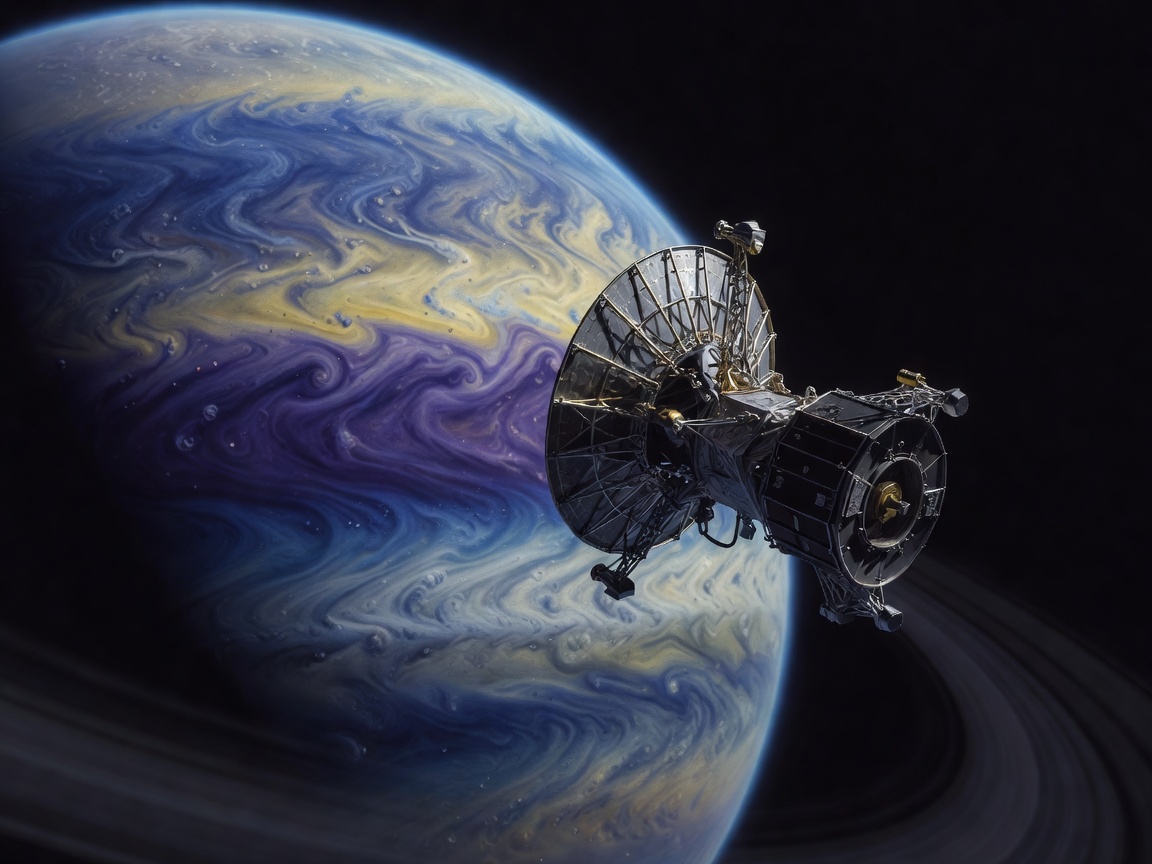
Navigating the Void
Sending a machine into Low Earth Orbit is challenging; sending one to the outer planets or into interstellar space requires an entirely different engineering methodology. Deep space probes operate in extreme isolation, subjected to massive radiation doses, unimaginable cold, and light-delay limits that render real-time human control impossible.
To survive and return data for decades, a deep space probe must be heavily autonomous, possess ultra-reliable power systems, and carry highly specialized communication arrays capable of whispering scientific data across billions of miles.
Power Generation Beyond Mars
In the inner solar system, solar panels are highly effective. However, the inverse-square law dictates that sunlight intensity drops precipitously the further you travel from the sun. By the time a probe reaches Jupiter, solar irradiance is less than 4% of what it is at Earth. At Pluto, it is practically nonexistent.
To provide electricity to heaters, computers, and instruments in the outer dark, engineers utilize Radioisotope Thermoelectric Generators (RTGs). These devices do not use nuclear fission; instead, they rely on the natural radioactive decay of an isotope—usually Plutonium-238. As the material decays, it generates immense heat. Thermocouples convert this heat differential directly into direct current electricity. Because Plutonium-238 has a half-life of 87.7 years, an RTG can provide reliable, albeit slowly degrading, power for over half a century.
Communication & The Deep Space Network
A probe's data is useless if it cannot be transmitted back to Earth. Deep space communication relies on high-gain parabolic antennas on the spacecraft pointing precisely at Earth. The signal power radiated by a probe in the outer solar system is often equivalent to a refrigerator lightbulb.
To catch these infinitesimally weak signals, space agencies utilize global networks of massive radio antennas, such as the Deep Space Network (DSN). Positioned 120 degrees apart around the Earth (in California, Spain, and Australia), these arrays ensure that as the Earth rotates, at least one antenna can always maintain line-of-sight with the distant spacecraft. Signal processing involves cryogenic cooling of the receiver electronics to reduce thermal noise, allowing the detection of signals arriving at less than a billionth of a billionth of a watt.
Orbital Mechanics and Gravity Assists
Chemical rockets cannot provide enough Delta-v to send heavy probes directly to the outer planets in a reasonable timeframe. Instead, trajectory designers employ gravity assists, or "slingshot" maneuvers. By carefully flying a probe close behind a moving planet, the probe steals a tiny fraction of the planet's orbital momentum.
This maneuver dramatically increases the probe's velocity relative to the sun without expending a drop of propellant. Complex planetary tours, such as those taken by the Voyager and Cassini missions, require years of computational modeling to align multiple gravity assists across various planetary bodies, bouncing the spacecraft from one planetary orbit to the next like a cosmic billiard ball.