Satellite Propulsion
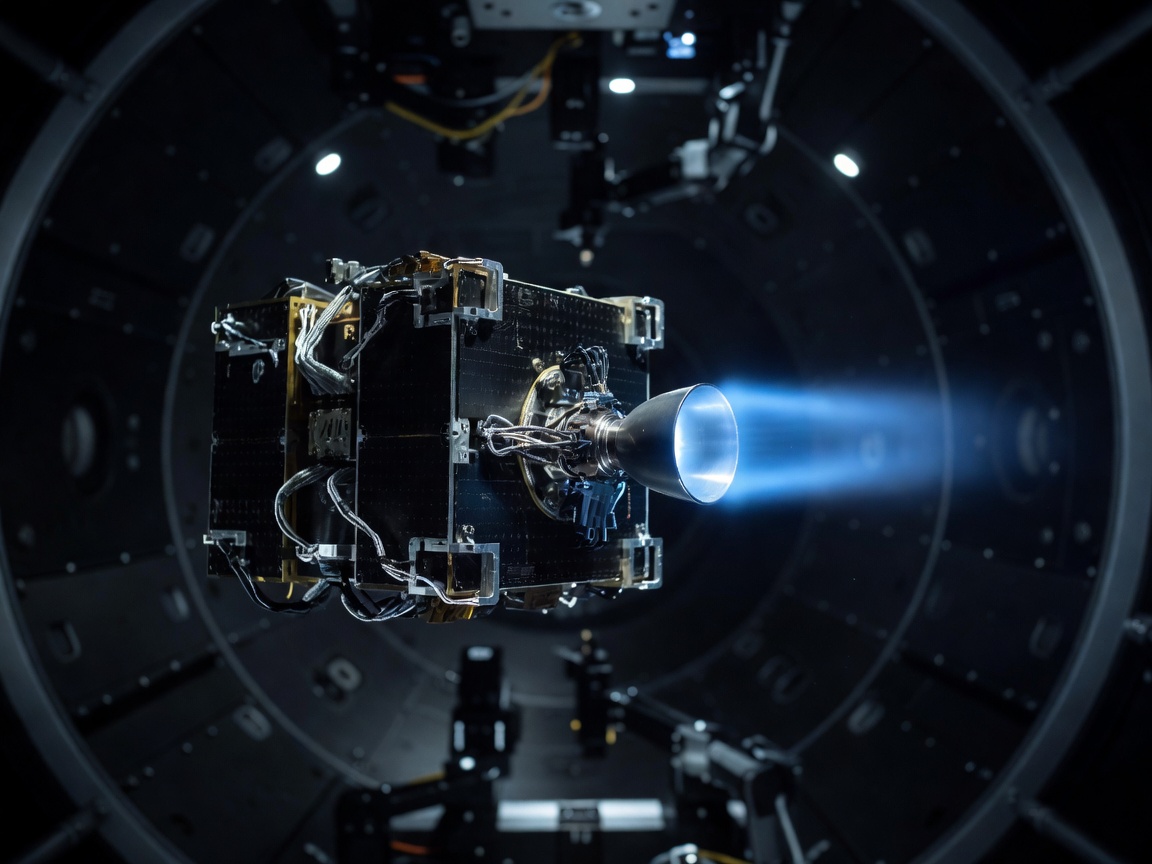
Maneuvering in the Vacuum
Once a spacecraft escapes the atmosphere and achieves orbit, the requirements for propulsion change dramatically. While launch vehicles require immense thrust to overcome Earth's gravity, in-space propulsion prioritizes specific impulse (fuel efficiency) above all else. Because bringing mass to orbit is exorbitantly expensive, a satellite's operational lifespan is dictated almost entirely by its onboard propellant budget, known as its Delta-v budget.
Satellites require propulsion for orbital insertion, phasing, station-keeping (counteracting atmospheric drag and lunar gravity perturbations), and eventual end-of-life deorbiting.
Chemical Propulsion Systems
Traditional satellite propulsion relies on chemical reactions, highly favored when short, high-thrust bursts are required—such as entering orbit around another planet. These are broadly categorized into two types:
- Monopropellant systems: Typically utilize hydrazine, a highly toxic liquid that decomposes violently when passed over a catalyst bed (usually iridium). While offering relatively low efficiency, they are structurally simple and highly reliable, making them the standard for attitude control thrusters.
- Bipropellant systems: Often combine hydrazine with nitrogen tetroxide. These are hypergolic, meaning they ignite spontaneously upon contact. This eliminates the need for an ignition system, providing reliable, repeatable starts for major orbital maneuvers like apogee kick burns to reach geostationary orbit.
Electric Propulsion and Ion Drives
For operations where time is not a critical constraint, Electric Propulsion (EP) has revolutionized satellite architecture. Instead of relying on the chemical energy stored in propellant, EP uses electrical energy (usually generated by solar panels) to accelerate ionized gas (plasma) to extraordinary velocities.
Hall-Effect Thrusters: The most common form of EP currently used in commercial satellite constellations. These devices trap electrons in a magnetic field to ionize a noble gas (most often Xenon or Krypton). The resulting positive ions are then accelerated out of the thruster by an electric field, generating thrust. While the thrust produced is incredibly low—often equivalent to the weight of a piece of paper resting on a hand—they can operate continuously for months or years. Over time, this constant, gentle acceleration yields massive changes in velocity while consuming a fraction of the propellant a chemical rocket would require.
The Delta-v Budget
Every maneuver a satellite makes subtracts from its inherent Delta-v budget. Station keeping in Low Earth Orbit requires constant small burns to counteract atmospheric drag. In Geostationary Orbit, satellites must perform north-south and east-west station keeping to fight the gravitational pull of the Sun and Moon, as well as the uneven gravity field of the Earth. A mastery of astrodynamics allows engineers to minimize these burns, often utilizing natural orbital perturbations to save precious fuel and extend the multibillion-dollar asset's operational life.